Quick Verdict
Best default choice: Rank Math, if you want more SEO features, schema controls, redirects, reporting, and better multi-site value.
Best editorial workflow: Yoast SEO, if writers need clearer readability guidance, internal-link suggestions, training, and a restrained publishing process.
Rankplot verdict: choose Rank Math for feature depth and site-portfolio value. Choose Yoast for editorial consistency. Neither plugin automatically improves rankings; configuration, search intent, original evidence, and internal links matter more.
Pricing and official feature details were checked on June 25, 2026. Prices exclude VAT where stated and can change.
Fast decision path: if you manage one writer-led site, start with Yoast. If you manage several personal sites or need deeper schema and technical controls, start with Rank Math.
Rank Math vs Yoast: Quick Comparison
| Category | Rank Math | Yoast SEO | Rankplot Pick |
|---|---|---|---|
| Best for | Technical users, multi-site owners, schema-heavy sites | Writers, editors, beginners, structured content teams | Depends on workflow |
| Free version | Broader feature set and modular controls | Strong core SEO and readability workflow | Rank Math |
| Entry paid price checked | PRO: $7.99/mo billed annually | Premium: $118.80/year | Rank Math on price |
| Renewal disclosed | PRO: $8.99/mo billed annually plus taxes | Verify at renewal/checkout | Rank Math for visible renewal |
| Sites per entry paid license | Unlimited personally owned sites | One website/domain | Rank Math |
| Focus keyphrases | Multiple; PRO lists unlimited optimization | Premium supports up to five per page | Rank Math for quantity; Yoast for guidance |
| Schema controls | More granular and extensible | More automated and simpler | Rank Math |
| Readability guidance | Useful checks | Mature, central part of the workflow | Yoast |
| Redirects | Built-in modular redirect tools | Included in Premium | Rank Math Free/value; tie in paid use |
| Rank tracking | Built into paid plans with plan limits | Not the core Premium proposition | Rank Math |
| Support | 24/7 support on PRO; priority on higher plans | 24/7 expert support with Premium | Tie |
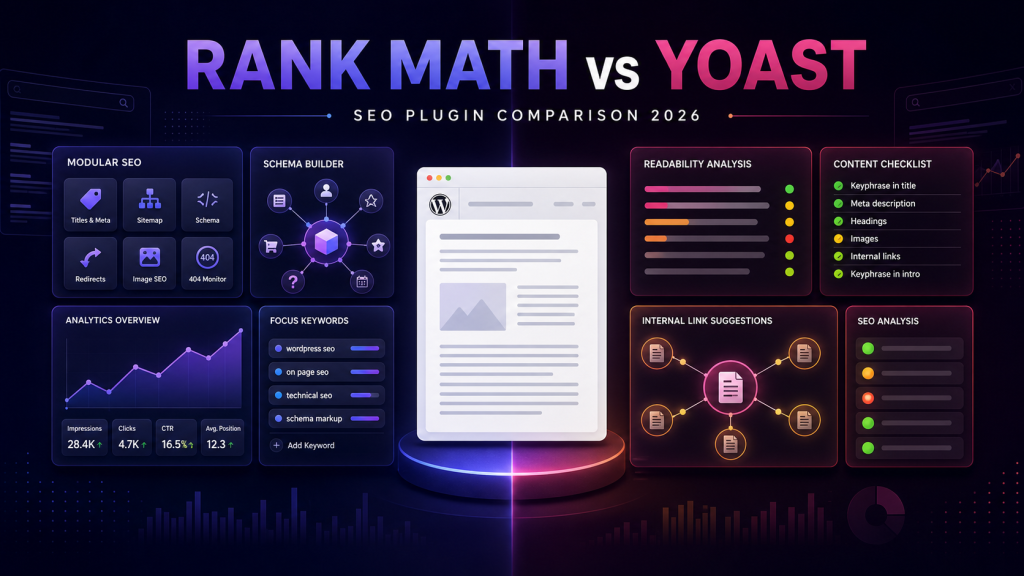
The headline difference is not that one plugin “does SEO” and the other does not. Both handle essential on-page and technical tasks. Rank Math exposes more tools and settings; Yoast puts more emphasis on guided writing and predictable editorial behavior.
Both are established plugins rather than speculative newcomers. Their official WordPress.org listings report more than 3 million active installations for Rank Math and more than 10 million for Yoast SEO. Install counts indicate adoption, not which plugin is better for a particular site.
Free Version Comparison
Rank Math Free is the stronger product when the goal is to cover more technical SEO tasks without paying immediately. Its modular design can handle titles and meta descriptions, XML sitemaps, schema options, redirects, 404 monitoring, image SEO settings, local SEO controls, and integrations from one interface. You can disable modules you do not need.
Yoast SEO Free covers the essentials well: search appearance controls, XML sitemaps, schema output, canonical handling, content analysis, and readability feedback. Its main advantage is discipline. A writer sees a familiar checklist and receives clear prompts about keyphrase placement, paragraph structure, transition words, sentence length, and other editorial signals.
The practical decision is simple:
- Choose Rank Math Free if you want redirects, broader schema controls, modular technical features, and fewer companion plugins.
- Choose Yoast Free if your main need is a dependable title, meta, sitemap, schema, and writing-assistance workflow.
Do not activate both to compare them on a live site. Two SEO plugins can output conflicting canonical tags, sitemaps, robots directives, and schema. Test on staging, export settings, and keep a rollback path.
Rank Math PRO vs Yoast Premium Pricing
| Plan | Price Checked June 25, 2026 | License Scope | Notable Limits / Features |
|---|---|---|---|
| Rank Math PRO | $7.99/mo billed annually; renews at $8.99/mo plus taxes | Unlimited personally owned websites; no client sites | 500 tracked keywords, advanced schema, reporting, 24/7 support |
| Rank Math Business | $24.99/mo billed annually; renews at $27.99/mo plus taxes | 100 client websites | 10,000 tracked keywords, client support, priority support |
| Rank Math Agency | $54.99/mo billed annually; renews at $64.99/mo plus taxes | 500 client websites | 50,000 tracked keywords and agency-scale limits |
| Yoast SEO Premium | $118.80/year excluding VAT | One website/domain | Five keyphrases, redirects, internal-link suggestions, AI title/meta help, social previews, 24/7 support |
The official Rank Math pricing page makes the multi-site advantage clear. PRO can be used on unlimited websites you personally own. Freelancers and agencies need Business or Agency for client sites.
The official Yoast SEO Premium page lists $118.80 per year excluding VAT and states that one subscription covers one website or domain. It also says Premium now includes its Local SEO, Video SEO, and News SEO plugins, plus one Google Docs add-on seat.
For one website, the annual prices are close enough that workflow matters more than a small price difference. For several personally owned sites, Rank Math’s license structure is decisively cheaper. For client sites, compare Rank Math Business against Yoast’s multi-license checkout rather than assuming the personal PRO license covers agency work.
Content Optimization and Readability
Yoast has the stronger editorial identity. Its traffic-light feedback is easy to teach, and its readability analysis gives writers a shared definition of “ready for review.” Premium supports up to five keyphrases per page, including related terms and variations, and adds internal-link suggestions. This is useful when several people publish into the same WordPress site.
Rank Math supplies a detailed SEO score and lets users optimize around multiple focus keywords. The interface gives more granular checks and tends to reward users who understand why a recommendation matters. That depth is useful, but it can create a false sense that reaching 100/100 is the objective.
Neither score is a Google ranking factor. Treat plugin checks as quality-control prompts, not as instructions to repeat a keyphrase until every indicator turns green. A page can score well and still fail because it targets the wrong intent, adds no original evidence, or provides a worse answer than competing pages.
Winner for writers and teams: Yoast. Winner for users who want more settings and keyword flexibility: Rank Math.
Schema and Technical SEO
Both plugins generate a connected schema graph and handle common technical foundations such as canonical URLs, XML sitemaps, robots controls, and search appearance templates. The difference is how much control they expose.
Rank Math is stronger for advanced schema work. Its paid plans include a custom schema builder, schema templates, imports, multiple schemas, validation tools, and support for a large schema vocabulary. It is the better fit when a publisher needs repeatable schema rules across custom post types, product content, local pages, videos, or specialized editorial formats.
Yoast is stronger when the goal is to make correct baseline output automatic. Premium includes Local, Video, and News SEO features, which reduces the need to buy those extensions separately. A normal business site may prefer this lower-decision workflow over a larger schema control panel.
More schema is not automatically better. Markup must describe visible page content and follow Google’s eligibility rules. Before deployment, validate representative page types and check that your theme, WooCommerce extensions, or page builder are not outputting duplicate schema.
Redirects, 404 Monitoring, and Site Maintenance
Rank Math’s redirect and 404 modules are a major free-version advantage. They give a small site enough tooling to repair changed URLs and identify broken requests without installing another redirect plugin. Paid plans add more advanced controls and reporting.
Yoast places redirect management in Premium. Its workflow is particularly convenient when a user changes a post slug or deletes content because the plugin can prompt for the redirect during the editing action. That is less flexible than a technical toolkit, but it is difficult for an editor to miss.
Do not redirect every 404 to the homepage. Redirect only when there is a close replacement. Remove internal links to deleted URLs, preserve high-value external backlinks where possible, and return a real 404 or 410 when no equivalent page exists.
Analytics, Rank Tracking, and Reporting
Rank Math is the clear winner if you want search data inside WordPress. Its paid plans connect reporting, keyword tracking, index status, and per-post performance tools. PRO lists 500 tracked keywords, while Business and Agency increase that limit substantially.
Yoast Premium is not positioned as a rank tracker. Its value is guidance inside the publishing workflow rather than replacing a dedicated SEO platform. If competitive keyword research, backlink analysis, or large-scale rank tracking matters, neither plugin replaces a full suite such as those covered in Rankplot’s Semrush review, Ahrefs review, or Semrush vs Ahrefs comparison.
Keeping analytics inside WordPress is convenient, but it also adds data, scheduled tasks, and interface complexity. Search Console and your analytics platform remain the sources to verify before making editorial decisions.
Performance and Interface
There is no responsible universal answer to “Which plugin is faster?” Performance varies with enabled modules, hosting, database size, WordPress version, theme, other plugins, cron behavior, and whether analytics data is stored or fetched.
Rank Math exposes more modules, so it gives administrators more opportunities to disable what they do not use. The tradeoff is a larger settings surface. Yoast is more opinionated and usually easier for an editorial user to navigate, although its dashboard also promotes paid features and integrations.
Test the actual configuration, not a blank plugin install. Record front-end requests, admin editor responsiveness, scheduled actions, database growth, and sitemap generation on staging. Rankplot’s testing methodology explains why controlled conditions matter.
Migrating Between Rank Math and Yoast
Both ecosystems provide migration paths, but changing the SEO layer of an established site is not a cosmetic plugin swap. Titles, descriptions, canonical settings, noindex rules, redirects, breadcrumbs, sitemap URLs, and schema can change.
- Back up the database and files.
- Export the existing plugin’s settings when possible.
- Clone the site to staging.
- Import metadata into the new plugin.
- Compare source output for representative posts, pages, categories, products, and custom post types.
- Check canonical tags, robots directives, schema, breadcrumbs, and XML sitemaps.
- Keep only one SEO plugin active after migration.
- Crawl the site and monitor Search Console after release.
If the current setup is stable and the new plugin does not solve a defined problem, switching may create more risk than value. Plugin choice matters less than preserving correct output.
Best Plugin by Use Case
| Use Case | Best Choice | Why |
|---|---|---|
| Best free SEO plugin for maximum features | Rank Math | Broader technical toolkit, redirects, 404 monitoring, and modular controls |
| Best for beginner writers | Yoast SEO | Clear content and readability feedback with fewer decisions |
| Best for multiple personal sites | Rank Math PRO | Unlimited personally owned websites under the checked license |
| Best for an editorial team | Yoast Premium | Consistent writing guidance, internal-link suggestions, training, and support |
| Best for advanced schema | Rank Math PRO | Custom builder, templates, imports, validation, and multiple schemas |
| Best for local, video, and news features in one paid package | Yoast Premium | Those three Yoast plugins are included |
| Best for in-dashboard rank tracking | Rank Math PRO | Tracked-keyword allowances and performance reporting |
| Best for WooCommerce technical control | Rank Math PRO | Deeper WooCommerce SEO controls in the paid feature set |
| Best for agencies | Compare licenses | Rank Math Business/Agency has explicit client-site limits; Yoast uses per-site subscriptions with bulk options |
For a deeper look at Rank Math itself, read Rankplot’s Rank Math SEO review. You can also browse the WordPress plugins hub for related tools.
Final Verdict
Rank Math wins the overall value comparison. The free version covers more operational SEO tasks, and PRO’s unlimited personal-site license is difficult for Yoast’s one-site subscription to match. It is the stronger choice for technical owners, niche-site portfolios, advanced schema, and users who want reporting inside WordPress.
Yoast wins the editorial workflow comparison. Its readability system, content guidance, internal-link suggestions, training resources, included Local/Video/News functionality, and 24/7 Premium support make it easier to standardize how a team publishes.
Choose the plugin whose workflow your team will use correctly. Then configure it once, document the settings, validate the output, and spend the rest of the effort on search intent, original evidence, internal linking, and content maintenance.
Frequently Asked Questions
Is Rank Math better than Yoast?
Rank Math is better for free feature depth, schema controls, rank tracking, and multi-site value. Yoast is better for readability guidance, editorial consistency, and a simpler writing workflow.
Is Rank Math Free better than Yoast Free?
Rank Math Free is the stronger value choice for hands-on site owners who want more technical controls. Yoast Free is still a strong choice for users who mainly need dependable metadata, sitemaps, schema, and writing feedback.
Which is cheaper, Rank Math PRO or Yoast Premium?
On June 25, 2026, Rank Math PRO was listed at $7.99 per month billed annually, renewing at $8.99 per month plus taxes. Yoast Premium was $118.80 per year excluding VAT. Rank Math is cheaper for multiple personally owned sites because its PRO license covers unlimited personal websites.
Can I use Rank Math and Yoast together?
No. Running both can create duplicate or conflicting canonical tags, schema, sitemaps, metadata, and robots directives. Use a migration tool on staging, verify the output, and keep one SEO plugin active.
Will switching from Yoast to Rank Math hurt rankings?
A correct migration should preserve essential metadata and directives, but a careless switch can change titles, canonicals, noindex rules, redirects, schema, and sitemaps. Back up, test on staging, crawl the result, and monitor Search Console.
For alternatives beyond these two products, compare the five best WordPress SEO plugins for 2026.