
Disclosure: This article contains affiliate links. If you buy through them, Rankplot may earn a commission at no extra cost to you. Recommendations are based on use case fit, public plan data, available screenshots, and workflow analysis, not on guaranteed ranking outcomes.
This Semrush Review 2026 is a practical buyer’s review of Semrush for SEO, AI visibility, competitor research, rank tracking, and reporting. The previous version of this page used stronger first-person testing language than the evidence currently available in the Rankplot work folder supports. This update corrects that: it separates official plan data, visible screenshot evidence, and editorial analysis.
Quick verdict: Semrush is one of the broadest SEO and AI search visibility platforms available in 2026. It is strongest for marketers, agencies, consultants, and site owners who need keyword research, daily rank tracking, site audit, competitor research, AI visibility reporting, and reporting in one workflow. It is not the cheapest option for beginners, and it should not replace Google Search Console for your own site data.
Semrush Review 2026: Who It Is Best For
| User type | Fit | Why |
|---|---|---|
| SEO consultants | Strong | Useful mix of keyword research, rank tracking, site audit, competitor analysis, and reports. |
| Small agencies | Strong | Works well when several client workflows need one dashboard. |
| Content teams | Strong on higher plans | Content and historical-data workflows become more useful above entry level. |
| Brands tracking AI visibility | Strong | Current Semrush plans now include AI visibility features at several tiers. |
| New bloggers | Usually wait | Google Search Console and free tools are enough until competitor research and tracking justify the cost. |
| Pure backlink specialists | Compare Ahrefs | Ahrefs may still fit better when backlinks and link prospecting are the main job. |
What Semrush Is in 2026
Semrush has moved beyond a classic keyword research tool. In 2026, its pricing page frames the product around SEO plus AI Search plans, with website monitoring, keyword tracking, Site Audit, AI visibility reporting, AI prompt tracking, and add-on reporting options. That positioning matters because search visibility now includes Google results, AI Overviews, ChatGPT-style answers, and brand mentions across multiple surfaces.
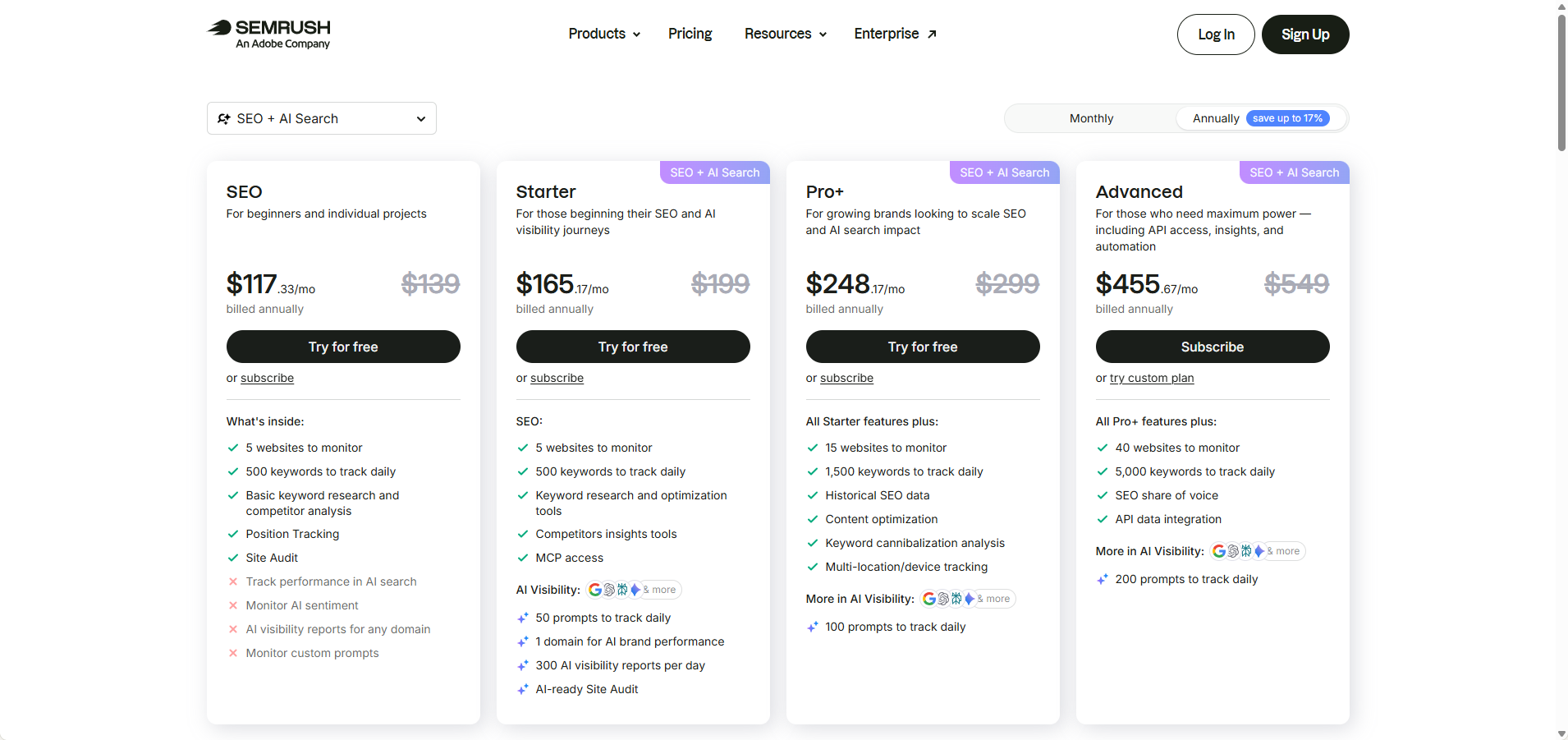
Semrush Pricing Checked July 8, 2026
Semrush pricing changes often, so treat this as a checked snapshot, not a permanent price guarantee. On July 8, 2026, the official Semrush pricing page showed annual-billing prices for SEO and AI Search plans as follows.
| Plan | Annual billing price shown | Monthly equivalent shown | Visible limits or positioning |
|---|---|---|---|
| SEO | $117.33/mo billed annually | $139/mo crossed price shown | 5 websites, 500 daily tracked keywords, Position Tracking, Site Audit, and AI search monitoring features. |
| Starter | $165.17/mo billed annually | $199/mo crossed price shown | SEO plus AI Search; 5 websites, 500 tracked keywords, MCP access, 50 prompts daily, 1 AI brand performance domain, 300 AI visibility reports daily. |
| Pro+ | $248.17/mo billed annually | $299/mo crossed price shown | 15 websites, 1,500 tracked keywords, historical SEO data, content optimization, cannibalization analysis, multi-location/device tracking. |
| Advanced | $455.67/mo billed annually | $549/mo crossed price shown | 40 websites, 5,000 tracked keywords, share of voice, API data integration, 200 prompts daily. |
| Free | $0/mo | $0/mo | 1 demo project and limited daily reports. |
The practical takeaway: Semrush is expensive if you only need occasional keyword checks. It starts to make more sense when you use several workflows at once: keyword research, rank tracking, audits, competitor research, AI visibility, and reporting.
Core Features That Matter Most
| Feature | What it does | Rankplot assessment |
|---|---|---|
| Keyword research | Finds keyword ideas, intent patterns, difficulty signals, and competitor opportunities. | Strong for breadth and planning, but always verify priority terms with Search Console and live SERPs. |
| Position Tracking | Tracks rankings for selected keywords across devices and locations. | Useful for active campaigns because daily tracking is visible in the current Semrush plan structure. |
| Site Audit | Crawls a site and reports technical issues, warnings, notices, and AI-readiness-related signals. | Useful for prioritization, but do not treat every warning as equally important. |
| Competitor research | Shows competing domains, traffic estimates, keywords, backlinks, and market context. | Good directional intelligence. Do not use third-party estimates as exact financial data. |
| AI visibility | Tracks AI search visibility, prompts, reports, and brand performance depending on plan. | One of Semrush’s clearest 2026 differentiators, especially for brands that care about AI answers. |
| Reporting | Creates scheduled reports and can connect data sources depending on plan/add-ons. | Valuable for consultants and agencies; less important for a solo site owner. |
Screenshot Evidence: Backlinko.com Sample
For the July 2026 Semrush vs Ahrefs comparison, Rankplot used a public, well-known SEO domain, `backlinko.com`, as a sample instead of a small private site. That is a better evidence pattern because readers can understand the domain context and the visible numbers are not based on an obscure property.

This screenshot supports a limited claim: Semrush can expose domain overview, organic search, backlink, and AI visibility style metrics for a public domain. It does not prove that every Semrush metric is exact, and it does not prove a 90-day test of Semrush across multiple private sites.
Data Accuracy: How to Use Semrush Safely
Semrush estimates are useful for comparison and prioritization, but they are not your source of truth for your own traffic. Use Semrush to discover patterns, compare competitors, and build a hypothesis. Use Google Search Console, analytics, server logs, and sales data to confirm whether the hypothesis is actually true for your site.
| Data type | Best source | How Semrush should be used |
|---|---|---|
| Your actual clicks and queries | Google Search Console | Secondary context only. |
| Your conversions and revenue | Analytics, CRM, checkout, forms | Never estimate revenue from Semrush alone. |
| Competitor keyword ideas | Semrush plus live SERPs | Strong discovery source. |
| Competitor traffic scale | No perfect public source | Directional estimate, not a hard number. |
| Backlink opportunities | Semrush, Ahrefs, manual review | Use for prospect lists, then manually qualify. |
Semrush vs Free Tools
If your site is new, start with a free stack before paying for Semrush. A practical free stack is Google Search Console, Google Analytics, Google Keyword Planner, the free tier of Screaming Frog, and limited free SEO tool checks. This will not replace competitor research or daily campaign tracking, but it prevents you from paying for a platform before you have enough content, impressions, or revenue to act on the data.
| Need | Free stack | When Semrush becomes useful |
|---|---|---|
| Know your own queries | Google Search Console | When you need competitor gap analysis. |
| Find starter keywords | Keyword Planner, SERP autocomplete, manual SERP review | When you need scale, filters, and competitive context. |
| Basic crawl | Screaming Frog free limit | When site audit needs to be repeated and reported. |
| Track priority terms | Manual checks, GSC averages | When daily rank movement affects campaigns or clients. |
| Report to clients | Manual dashboard | When scheduled reports save enough time to justify cost. |
Semrush vs Ahrefs
The short version: Semrush is better when you want one broader platform for SEO, AI visibility, PPC context, reporting, and campaign management. Ahrefs is often better when your main work is backlink analysis, link prospecting, and focused organic SEO research. For the detailed current comparison, read Semrush vs Ahrefs 2026.
| Use case | Better first choice | Why |
|---|---|---|
| Agency reporting across SEO and content | Semrush | Broader workflow and reporting fit. |
| AI visibility monitoring | Semrush | AI visibility features are now prominent in Semrush’s pricing structure. |
| Backlink prospecting | Ahrefs | Cleaner specialist workflow for many SEO teams. |
| Solo site with limited budget | Neither immediately | Use free tools until you have enough demand and content to justify paid data. |
| Daily rank tracking for campaigns | Semrush | Current Semrush plans visibly include daily keyword tracking allowances. |
Pros and Cons
Pros
- Broad SEO and AI search visibility platform.
- Daily keyword tracking allowances are visible in current plans.
- Useful competitor research and reporting workflows.
- Good fit for consultants and agencies that need repeatable reporting.
- Public pricing page gives clear limits for websites, keywords, prompts, and reports.
Cons
- Too expensive for many new bloggers and early affiliate sites.
- Third-party traffic estimates are directional, not exact.
- Plan names and pricing have changed, so old reviews can become stale quickly.
- Feature breadth can overwhelm users who only need one workflow.
- Some add-ons and reporting options can raise the real cost.
Final Verdict
Semrush is worth considering if SEO, AI search visibility, competitor research, rank tracking, and reporting are active business workflows for you. It is not necessary for a brand-new site that has little content and almost no Search Console data. The best time to pay for Semrush is when you already have pages to improve, competitors to analyze, keywords to track, and enough commercial upside that better decisions can repay the subscription.
For Rankplot’s current evidence standard, this page should be read as a documentation-based and screenshot-supported review, not as a 90-day lab test. That narrower framing is more honest and more useful: Semrush is powerful, but the decision should be based on your workflow, budget, and ability to act on the data.
FAQ
Is Semrush worth it for beginners?
Usually not at the start. Beginners should begin with Google Search Console, analytics, and free research tools. Semrush becomes more useful once you need competitor research, daily tracking, repeatable audits, or client reporting.
Does Semrush replace Google Search Console?
No. Google Search Console is the source of truth for your own Google queries, impressions, clicks, and indexing signals. Semrush is better for research, competitive context, rank tracking, and market discovery.
Which Semrush plan should most users start with?
Start with the lowest plan that covers your actual workflow. On July 8, 2026, the official pricing page showed the SEO plan at $117.33/mo billed annually and the Starter SEO + AI Search plan at $165.17/mo billed annually. Recheck the official page before buying.
Is Semrush better than Ahrefs?
Semrush is usually better for broader marketing workflows, AI visibility, rank tracking, reporting, and campaign management. Ahrefs is often better for focused backlink research and specialist SEO workflows.
Can Semrush traffic estimates be trusted?
They can be useful directionally, especially for comparing competitors, but they should not be treated as exact traffic or revenue numbers. Use Search Console and analytics for your own site.