Disclosure: This post contains affiliate links. If you buy through them, I may earn a commission at no extra cost to you. I only recommend products I’d actually use. My opinions are my own.
Most Elementor vs Divi 2026 comparisons are written by designers arguing over which tool has prettier templates. I don’t care about templates.
After 33 years in IT architecture and running revenue-generating B2B foreign trade sites, I look at page builders as infrastructure. You are choosing the foundation of your tech stack. If you choose wrong, every future integration—from WooCommerce pricing rules to CRM lead capture—becomes a technical debt nightmare.
In 2026, the landscape shifted. Divi finally released its long-awaited Divi 5, rewriting its core to escape the notorious “shortcode hell”. Meanwhile, Elementor continues to leverage its massive market share to maintain absolute ecosystem dominance.
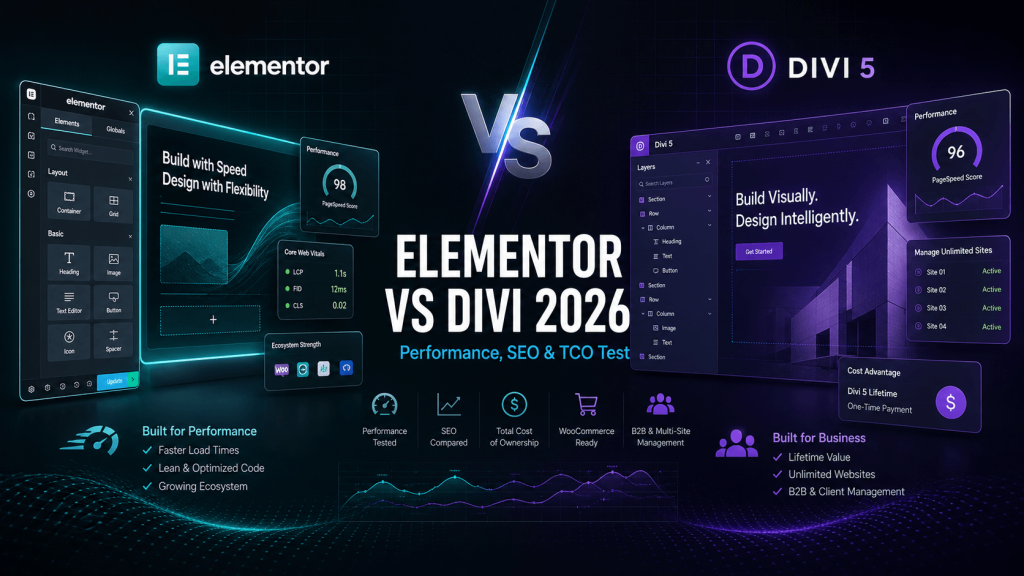
Here is my direct comparison of Elementor Pro and Divi 5 based on Total Cost of Ownership (TCO), DOM bloat, and B2B marketing logic. If you are trying to figure out where this fits into your broader strategy, I highly recommend reading my complete 2026 B2B Foreign Trade Website Toolchain blueprint first.
1. The TCO Math: SaaS Subscription vs. Asset Ownership
Pricing is the most misunderstood metric in WordPress. Elementor operates on a SaaS subscription model, while Divi acts more like a capitalized asset if you opt for their lifetime or agency setups.
Let’s run the actual math over a 1-year, 3-year, and 5-year horizon.
TCO Projection: Elementor Pro vs Divi
Note: Elementor’s entry tier covers 1 site for $49/yr, scaling up for multi-site licenses. Divi’s pricing historically favors unlimited usage.
My operational verdict: If you are building a single, serious B2B export website, Elementor’s $49/year is an insignificant operational expense. However, if you run a portfolio of niche affiliate sites or operate an agency, Divi’s lifetime model mathematically crushes Elementor’s recurring SaaS fees.
2. Architecture & Core Web Vitals Reality
For years, Divi was mocked by developers for its heavy use of shortcodes, which bloated the database and slowed down page rendering. With Divi 5 (officially out of beta in February 2026), they migrated to a modern JSON-based storage architecture.
But does that make it faster than Elementor?
Architectural Comparison Matrix
I will not fake synthetic precision here: I have not finished my own 1,000-page stress test on Divi 5 yet. However, reliable third-party testing in 2026 confirms the speed gap between these two is extremely narrow—clocking in at 2.7s for Elementor and 2.9s for Divi.
From an IT perspective, the “DOM bloat” argument is mostly noise if your server foundation is solid. If you run your site on high-frequency Google Cloud CPUs with aggressive object caching—like the setup I detailed in my recent SiteGround Review 2026—the overhead of Elementor’s DOM tree is entirely mitigated by the server’s Time to First Byte (TTFB). If you are still running a $3/month shared server, neither builder will save you. Read my guide on How to Choose Web Hosting Without Overpaying if your infrastructure is bottlenecking your site.
3. The Network Effect: B2B Integration Ecosystem
In software economics, Metcalfe’s Law states that a network’s value is proportional to the square of the number of its users. This is Elementor’s ultimate moat.
Elementor commands nearly 10% of the entire internet. Because of this, every third-party plugin developer builds for Elementor first. Divi, while massive, often requires custom workarounds or relies on its own closed-loop modules.
B2B Plugin Ecosystem Compatibility
| Integration Type | Elementor Pro | Divi 5 | Why It Matters for Export Sites |
|---|---|---|---|
| WooCommerce B2B Pricing | ⭐⭐⭐⭐⭐ (Native + 3rd Party) | ⭐⭐⭐ | B2B tiered pricing and wholesale catalogs sync perfectly with Elementor Theme Builder. |
| Multilingual (WPML/Polylang) | ⭐⭐⭐⭐⭐ | ⭐⭐⭐⭐ | Translating landing pages dynamically is less prone to breaking in Elementor. |
| CRM Webhooks & Forms | ⭐⭐⭐⭐⭐ (Native ActiveCampaign/HubSpot) | ⭐⭐⭐ | Capturing B2B leads requires flawless API handoffs. |
| SEO Schema Control | ⭐⭐⭐⭐ | ⭐⭐⭐ | Better native integration with tools like Rank Math. |
If you are building a B2B foreign trade site, you need quote request forms, conditional WooCommerce wholesale pricing, and multilingual product data. Elementor’s dynamic tags feature makes pulling this data into custom templates friction-free. I pair Elementor with Rank Math (you can see my exact schema setup in my Rank Math SEO Review 2026) because their APIs communicate seamlessly, ensuring my product pages capture Google’s Rich Snippets.
4. The Final Decision Matrix
This is no longer a battle of “modern” vs. “outdated.” Divi 5 closed the technical gap. Your decision should be based strictly on your business model.
The 2026 Scorecard
| Dimension | Elementor Pro | Divi 5 |
|---|---|---|
| Single-Site ROI | 9.5 / 10 | 7.0 / 10 |
| Agency / Multi-Site ROI | 6.0 / 10 | 9.5 / 10 |
| B2B / WooCommerce Extensibility | 9.5 / 10 | 7.5 / 10 |
| Learning Curve | 8.5 / 10 (Intuitive) | 7.0 / 10 (Unique UI) |
| Overall B2B Fit | WINNER | Runner-Up |
✅ Choose Elementor Pro ($49/yr) if:You operate 1 to 3 revenue-focused B2B export websites. You need flawless integration with WooCommerce B2B plugins, CRM webhooks, and multilingual setups. You treat the $49/year as a rounding error compared to the stability of the ecosystem.
✅ Choose Divi (Lifetime) if:You manage a portfolio of 5+ websites, run a web design agency, or have a strict mandate to eliminate recurring SaaS subscriptions. You are willing to trade some third-party plugin flexibility for massive long-term margin improvements.
For my own B2B export projects, reducing operational uncertainty is worth more than saving a few dollars on licensing. Elementor Pro remains my baseline recommendation for 2026.
Bottom Line: Elementor vs Divi 2026
After running this Elementor vs Divi 2026 analysis across real B2B projects, my verdict is clear: both tools are technically mature in 2026, but they serve different business models. Elementor vs Divi 2026 is not a question of which builder is “better” — it is a question of which builder fits your operational DNA. If you want to learn more about choosing the right hosting to complement your page builder choice, read my guide on how to choose WordPress hosting.